Voice AI vs. The Legacy Interpretation Booth: The New Keynote ROI
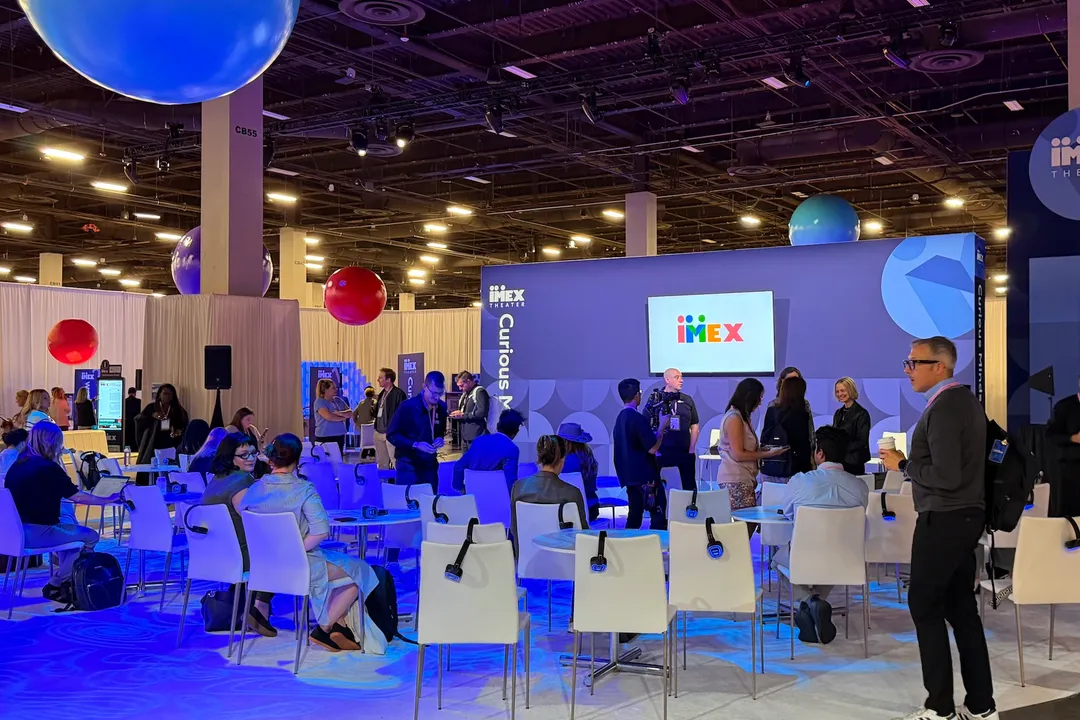
Live presentation stage on the exhibition floor at IMEX America in Las Vegas. Photo: LandingInVegas Editorial Team
Las Vegas’s mega-convention facilities—from the 1.4-million-square-foot column-free West Hall at the Las Vegas Convention Center (LVCC) to the massive multi-level ballrooms of Mandalay Bay and The Venetian Expo—represent modern engineering triumphs. Yet with 40-foot ceilings, polished concrete floors, and industrial HVAC units pushing ambient floor noise to 80 to 85 decibels, these venues present an unforgiving acoustic battleground. When global summits including CES, AWS re:Invent, Money20/20, and IMEX America convene tens of thousands of international delegates, cross-language failure is not a minor AV glitch; it is a multi-million-dollar breakdown in deal velocity, sponsor retention, and brand authority.
Historically, addressing this required a punishing logistical apparatus: heavy soundproof glass interpretation booths, teams of flown-in linguists, and thousands of fragile radio-frequency (RF) headsets plagued by battery failures and distribution bottlenecks. Today, enterprise summits are retiring the physical booth entirely. Powered by breakthroughs in acoustic digital signal processing (DSP), browser-based Bring Your Own Device (BYOD) distribution, and real-time sentiment analytics, tier-one organizers are replacing cumbersome hardware with cloud-native voice AI and live cognitive telemetry.
1. The Acoustic Battleground: The 85dB Convention Floor Problem
Standard speech-to-text tools work seamlessly in a quiet boardroom, but they routinely collapse inside a 100,000-square-foot convention hall. With polished concrete floors, 40-foot steel ceilings, and ambient crowd noise reaching 80 to 85 decibels, sound bounces across the room for nearly three seconds, turning clear presenter speech into an echoing wall of noise.
When consumer AI tools try to process this echo-heavy audio, they choke—dropping critical words, lagging behind the presenter, or generating nonsensical “hallucinations.” Delivering reliable multilingual keynotes at mega-convention scale requires isolating clean audio directly from the venue sound system, rather than relying on everyday meeting apps.
Off-the-shelf consumer speech models fail in large convention halls for three simple reasons:
- Background Noise Bleed: Crowd hum, neighboring booth demos, and overhead announcements leak into the mic, causing the AI to miss or mangle words.
- Severe Hall Echo: Sound bouncing off 40-foot ceilings and concrete floors blurs speech, tricking the AI into hearing words that were never spoken.
- Cross-Stage Chatter: On open show floors, audio from adjacent presentations bleeds across aisles, confusing the AI and mixing up competing conversations.
Overcoming this requires deep acoustic engineering. Enterprise AI leader Wordly—founded by CEO Lakshman Rathnam, who holds over 25 patents and spent two decades directing audio hardware at Apple (contributing to the original iPod) and Amazon Lab126—solves this at the source: by plugging directly into the venue’s main sound board, the system isolates clean presenter audio and strips away background noise and hall echo before speech ever reaches the AI model.
2. The CapEx and Logistics Crisis: Moving Beyond the RF Headset
For more than four decades, simultaneous human interpretation has imposed massive capital expenditure, operational friction, and strict access rationing.
The Physical Burden of the Legacy Booth
A traditional simultaneous interpretation deployment for a three-day Las Vegas convention requires an exhaustive logistical footprint:
- Soundproof Glass Booths: Bulky 6×6-foot enclosures weighing over 600 pounds, requiring union labor, drayage fees, and ballroom space costing $15,000 to $30,000 per stage.
- RF Radio Infrastructure: Specialized FM or infrared transmitters, multi-channel splitters, and bulky multi-bay charging racks.
- Hardware Inventory Shrinkage: Handing out physical headsets at distribution desks creates registration bottlenecks and drives a predictable 10% to 15% hardware loss and damage rate per event.
The “Keynote Isolation Trap”
Because of these prohibitive costs, event organizers were forced into what industry analysts term the “Keynote Isolation Trap.”
Organizers budgeted for human interpretation strictly for the main morning keynote in the primary ballroom, covering only two or three dominant languages (typically Spanish and Mandarin). Meanwhile, the remaining 50+ technical breakout tracks, masterclasses, and executive roundtables remained English-only—effectively shutting out hundreds of international buyers from the working core of the event.
“AI is fundamentally changing the economics of multilingual communication. Historically, providing interpretation at a large event meant significant advance planning, specialized equipment, interpreter coordination and substantial costs. As a result, organizers often had to limit the number of languages offered, leaving many international attendees unable to fully participate.
Wordly has delivered more than one billion minutes of translation and helped customers save more than $200 million compared with traditional approaches. Those numbers demonstrate that multilingual communication is no longer simply a logistical expense. It is an investment in audience participation, customer experience and the commercial potential of global events. For a destination like Las Vegas, where international trade shows and conventions generate significant economic activity, making every attendee feel included and able to participate is good for both the event and the broader business ecosystem.”

The Cloud-Native BYOD Paradigm Shift
By moving interpretation entirely into the cloud, enterprise platforms like Wordly eliminate physical hardware entirely through a Bring Your Own Device (BYOD) architecture:
- Zero Hardware Checkouts: Attendees simply scan a dynamic QR code projected on keynote stage screens or printed on event lanyards.
- Frictionless Browser Audio: With zero app downloads or account logins required, attendees access synchronized live audio and localized captions in over 60 languages directly on their personal smartphones, tablets, or laptops.
- Campus-Wide Scalability: Because the system requires only an audio feed from the audio console, organizers can scale multilingual translation across 50+ simultaneous breakout sessions at a fraction of the cost of a single physical booth.
| Architectural Dimension | Legacy Physical RF Setup | Enterprise Cloud-Native BYOD (Wordly) |
|---|---|---|
| Hardware Required | Soundproof glass booths, RF receivers, headsets, charging racks | Zero attendee hardware (Personal smartphone / browser) |
| Language Coverage | 2 to 3 languages maximum (prohibitive human cost) | 60+ languages simultaneously |
| Campus Reach | Main Keynote Ballroom only (Isolation Trap) | All breakout sessions, workshops, and expo stages |
| Setup & Lead Time | 2 to 3 days of freight, drayage, and booth assembly | Plug-and-play audio feed in under 15 minutes |
| Equipment Shrinkage | 10% – 15% unreturned or damaged headsets | 0% hardware risk |
| Enterprise Integrations | Standalone analog patch cables | Native Cvent Attendee Hub, Zoom, and Teams integration |
3. From Passive Audio to Cognitive Telemetry: Moving Beyond the 72-Hour Survey
While eliminating hardware CapEx is an immediate operational win, the true strategic breakthrough lies in Content Intelligence and Live Audience Telemetry.
For decades, enterprise event producers faced a glaring measurement blind spot: investing hundreds of thousands of dollars in high-production keynotes while remaining completely blind to real-time attendee absorption and disagreement.
The Failure of the 72-Hour Post-Event Survey
Traditional post-conference feedback loops suffer from three fatal flaws:
- The “Badge-Scan” Illusion: Scanning an executive’s badge at the entrance confirms physical attendance, but provides zero insight into cognitive engagement or disagreement.
- Low Survey Yield: Post-event email surveys sent 48 to 72 hours later routinely generate less than 5% response rates.
- Extreme Response Bias: Those few who do respond represent extreme outliers (ecstatic praise or complaints about room temperature), yielding zero actionable insight into specific slide resonance.
The Telemetry Shift: Rather than waiting days for low-yield post-event surveys, in-session telemetry turns every mobile screen into an active feedback sensor—capturing second-by-second sentiment, multilingual takeaways, and verified sponsor impressions while the keynote is still unfolding.
The Sentence-Level Telemetry Revolution
Wordly’s Audience Engagement suite transforms the live translation feed from a passive one-way display into a bidirectional in-session telemetry sensor.
Instead of merely reading scrolling subtitles, attendees actively engage with the presentation stream:
- Sentence-Level Emotional Reactions: Attendees tap real-time emoji reactions pegged directly to specific spoken statements. Event organizers receive a second-by-second sentiment curve showing exactly which slides, product reveals, or pricing models triggered excitement, alignment, or skepticism.
- Active Cognitive Highlighting: Non-native English delegates often struggle taking notes in a secondary language. With interactive highlighting, attendees tap and save key sentences in their native language, generating a personalized executive briefing ready for immediate export.
- Automated Post-Event Takeaways: Seconds after the keynote concludes, the platform generates structured multilingual summaries, allowing international executives to brief regional headquarters in Tokyo, Frankfurt, or São Paulo before the session video is even processed.
“For years, event organizers have had very limited visibility into what audiences actually think about a presentation while it is happening. They could measure attendance, conduct post-event surveys or look at session ratings, but those methods provide only a partial picture, often after the opportunity to act has passed.
Audience Engagement changes that by giving attendees a way to interact directly with the content during a live session. Rather than simply knowing how many people attended a keynote, organizers can begin to understand which ideas resonated, which topics generated reactions and where audience interest was strongest.
Ultimately, we are moving beyond measuring whether people showed up to understanding what they took away. That is a meaningful change in how organizations think about event value and return on investment.”
The High-Dwell-Time Sponsor Monetization Moat
This shift directly addresses a major commercial headache for event organizers: justifying keynote sponsorship pricing to Fortune 500 partners.
At tier-one trade shows, corporate sponsors pay upwards of $100,000 to $250,000 for stage naming rights and printed wall logos that attendees routinely walk past without looking up from their phones.
Wordly’s Sponsor Logos feature fundamentally alters this value proposition. By embedding prominent, clickable partner branding directly inside the mobile translation feed, the sponsor anchors their identity in front of attendee eyes for 45 to 60 minutes of continuous, highly focused dwell time. This transforms language accessibility into an active revenue engine, unlocking higher-tier sponsorship valuations backed by verified digital engagement data.
4. The 2027 Frontier: Ambient Multilingual Infrastructure on the Exhibition Floor
As neural speech synthesis latencies drop below conversational human thresholds and multimodal models mature, the frontier of event AI is moving far beyond the auditorium stage.
Today, real-time voice AI dominates structured, one-to-many keynote halls. Looking toward 2027, the critical battleground shifts to the unstructured, multi-speaker chaos of the trade show exhibition floor.
“I believe multilingual communication will increasingly become an invisible part of the event experience. Attendees should not have to think about whether they speak the same language as the person presenting or the person standing next to them. They should simply be able to communicate.
Looking toward 2027, I see significant opportunities beyond the traditional conference room. Imagine walking the exhibition floor at a major Las Vegas trade show and being able to understand a product demonstration, follow a conversation with an international exhibitor or participate in a business discussion without language being a barrier. The same technology that makes a keynote accessible in dozens of languages can help facilitate those connections across the broader convention environment.
The key will be making the experience device-agnostic and easy to access, without requiring specialized equipment or complicated setup. People should be able to use the devices they already carry and move naturally between presentations, meetings and conversations.”
5. The Strategic Executive Playbook: 3 Rules for Enterprise Event CTOs
For enterprise event producers, Chief Marketing Officers, and Fortune 500 meeting planners architecting multi-year summit roadmaps, transitioning to autonomous event intelligence requires three strategic decisions:
1. Perform a Full Total Cost of Ownership (TCO) Audit
Calculate the true all-in cost of traditional human translation: include not just interpreter hourly retainers, but freight shipping, drayage charges, union booth assembly, ballroom floor space forfeiture, and annual RF headset replacement costs. When evaluated comprehensively, cloud-native BYOD solutions routinely reduce total interpretation expenditures by over 70% while expanding language coverage tenfold.
2. Discontinue the “Keynote Isolation” Model
Stop treating multilingual access as a ceremonial perk reserved exclusively for the morning ballroom. Crucial deal-making, specialized technical training, and commercial partnerships happen in breakout rooms and technical workshops. Deploying campus-wide BYOD ensures non-native delegates receive full ROI from their registration fees across every session.
3. Replace Static Badge Metrics with Real-Time Cognitive Telemetry
Move beyond passive headcounts. Transition to platforms that capture real-time sentence-level sentiment, in-session participant notes, and automated executive takeaways. Equip corporate sponsors with verified, high-dwell-time digital screen exposure that directly connects event sponsorship investments to verified audience attention.
About the Author | Hao Qian, PhD
Hao Qian is the Founder & Editor-in-Chief of LandingInVegas.com. Holding a PhD in Computer Science with a background as a Silicon Valley technology leader, he provides analytical executive briefings on the intersection of artificial intelligence, luxury hospitality, and enterprise MICE logistics. He holds official accredited media credentials for major global summits including CES, Money20/20 USA, IMEX America, Global Gaming Expo (G2E), The SEMA Show, and AAPEX.
Read Full Editorial Bio & Press Credentials →More Executive Resources
- Top 5 Las Vegas AI & Cloud Conferences (2026–2027 Guide)
- Top 10 Biggest Las Vegas Trade Shows & Conventions (2026–2027 Ranked)
- Top 6 Las Vegas Convention Centers: 2026 Size & Venue Guide
- Money20/20 Las Vegas 2026: The Ultimate Executive Survival Guide
- IMEX America Las Vegas 2026: The Ultimate Executive Survival Guide
- The Intelligence of Exclusivity: How Real-Time AI and “Micro-Luxury” Redefined IMEX America 2026
- Las Vegas AI Corporate Travel Trends: How Silicon Valley is Redefining MICE
- Voice AI in Las Vegas Hotels: The Casino Resort PBX Guide
- CES 2027 Las Vegas: The Executive VIP Guide
- CES 2027: Top Enterprise AI Trends & Executive Insights