Voice AI in Las Vegas Hotels: The Casino Resort PBX Guide
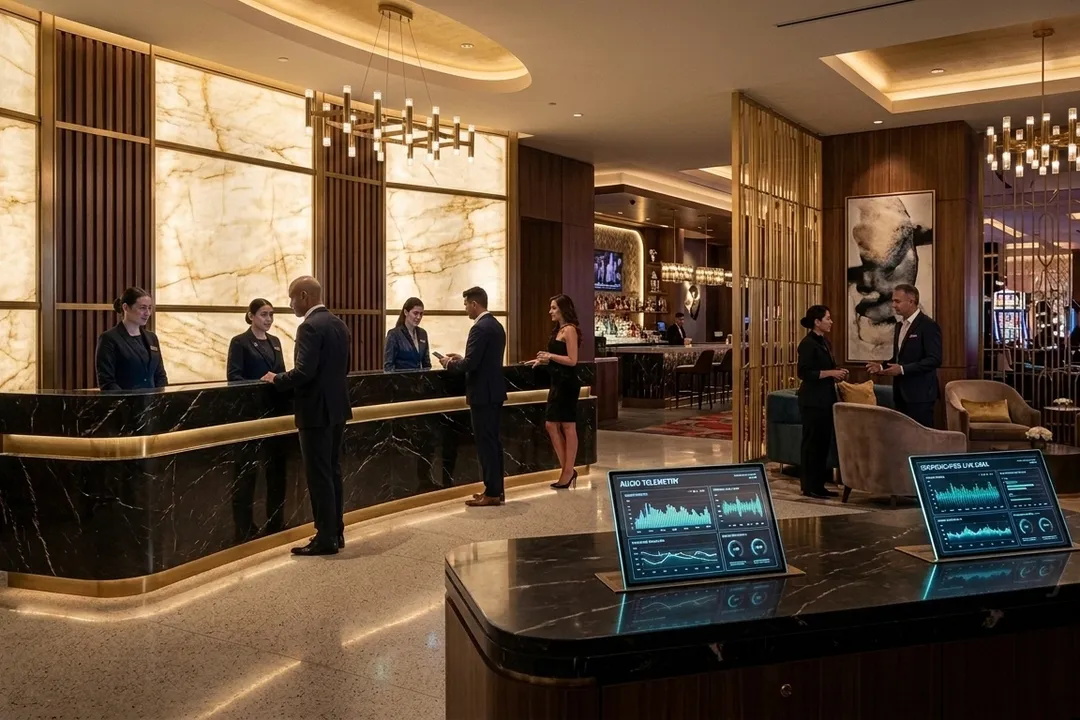
Luxury hospitality faces an operational paradox: while casino resorts sell high-touch guest experiences, their communication infrastructure relies on 1990s-era PBX telephony and siloed PMS databases. In a 4,000-room Las Vegas resort, this creates severe 20-minute phone queues during peak arrival windows, lost dining revenue, and frustrated VIPs.
Recent breakthroughs in Conversational Voice AI, Cascaded Small Language Models (SLMs), and real-time bi-directional audio streaming resolve this bottleneck. By bridging legacy telecom switches with neural speech pipelines, casino operators and Michelin-tier restaurants are deploying autonomous voice agents that resolve complex guest inquiries with sub-450ms latency.
1. The Legacy Bottleneck on the Las Vegas Strip
Managing real-time voice communications across mega-resort casino properties presents three critical operational failure points:
- The 4:00 PM Check-In Telephony Surge: At flagship properties like Bellagio, Wynn, and Fontainebleau, afternoon arrival surges generate over 10,000 inbound calls per day. Operators are overwhelmed by repetitive tier-1 inquiries—such as early check-in requests, luggage storage, resort fee details, and pool cabana availability—creating long hold times that degrade executive satisfaction.
- The High-Ticket Fine Dining Blindspot: During peak 7:00 PM dinner rushes, premier Strip steakhouses (such as Carversteak, CUT, and SW Steakhouse) miss up to 30% of incoming phone calls. These missed calls frequently represent unanswered $10,000 to $35,000 corporate private dining buyout inquiries lost to voicemail.
- Multilingual Executive Inefficiencies: Major global summits like AWS re:Invent, CES, and Money20/20 USA draw hundreds of thousands of international delegates. Traditional hotel switchboards cannot maintain 24/7 fluency across Asian and European languages, creating friction for high-net-worth foreign travelers.
2. The AI Architectural Blueprint: Under the Hood
Running massive 70B+ parameter LLMs for real-time voice creates 1,500ms to 2,500ms of latency, destroying natural conversational cadence. Instead, enterprise voice platforms use a Cascaded Audio Architecture engineered for strict sub-450ms end-to-end latency:
- Telephony & Ingestion (Twilio, Telnyx, LiveKit): The carrier gateway answers inbound calls via SIP trunking and opens a full-duplex WebSocket connection to the inference cluster, streaming 16kHz raw PCM audio in 20ms packets.
- Streaming Speech-to-Text (Deepgram Nova-2, Whisper Streaming): Transcribes raw audio into structured text tokens in under 120ms, using custom acoustic models trained on hospitality terminology and casino noise suppression.
- The Reasoning Brain & Tool-Calling (Cascaded SLMs on vLLM): A fine-tuned 8B Small Language Model (SLM) generates its first token in 60ms to 100ms. The SLM executes deterministic Pydantic tool calls against Oracle Opera Cloud PMS (room bookings, folio lookups) and SevenRooms / Tripleseat APIs (table reservations). Complex edge cases are asynchronously routed to frontier models (GPT-4o / Claude 3.5 Sonnet) while the primary voice agent maintains conversational flow.
- Neural Voice Synthesis (ElevenLabs Turbo v2.5, Cartesia Sonic): Synthesizes response text into warm, human-like concierge speech in under 100ms, complete with natural breath pauses and inflection.
Key Technical Mechanisms:
- Voice Activity Detection (VAD) & “Barge-In”: If a guest interrupts the AI, neural VAD algorithms terminate downstream TTS audio in under 50ms, allowing instant conversational pivots without voice overlap.
- Deterministic Schema Validation: Strict Pydantic JSON schemas prevent model hallucinations and ensure safe read/write transactions into hotel management databases.
3. Real-World Adoption Friction & Legacy Hurdles
Deploying voice AI across Tier-1 Las Vegas properties requires solving three distinct engineering and operational challenges:
- Antiquated On-Premises Telephony: Legacy properties often run closed, decades-old PBX hardware (Avaya, Mitel, Cisco). Bridging these analog/digital circuits to cloud-native WebSockets requires enterprise session border controllers (SBCs) and hybrid networking middleware.
- Extreme Casino Floor Noise: Inbound calls from gaming floors or noisy nightclub queues carry heavy acoustic interference. Speech-to-text engines require aggressive noise-filtering algorithms to strip out background slot machine audio and crowd chatter.
- Union Labor & Workforce Integration: Operating under Culinary Workers Union Local 226 agreements, forward-thinking operators position Voice AI not as job replacement, but as an automated Tier-1 triage buffer that handles repetitive FAQ calls so human concierge staff can focus on high-touch VIP service.
4. Vanguard Enterprise Case Studies & Comparative Architecture
Four enterprise voice AI platforms lead production deployments across hospitality, gaming, and dining:
PolyAI: Enterprise Casino PBX Call Containment
- Profile: Backed by $200M+ in funding (including an $86M Series D at a $750M valuation led by Khosla Ventures and NVIDIA NVentures).
- Vegas Track Record: At Golden Nugget Las Vegas (Landry’s), PolyAI autonomously resolves over 34% of all incoming hotel and restaurant reservation calls. Integrated with PCI Pal, it securely processes room deposit credit card payments over the phone. Also deployed across Caesars Entertainment properties.
Slang.ai: VIP Dining & Host-Stand Superhost
- Profile: Backed by $68M in funding (including a $36M Series B led by USVP and Homebrew), active across 2,000+ restaurant locations.
- Vegas Track Record: In its flagship Las Vegas deployment at Texas de Brazil Vegas, Slang.ai generated over 2,400 direct reservations with a 96.4% Customer Satisfaction (CSAT) rating. Features native real-time sync with SevenRooms, Tripleseat, and OpenTable to capture corporate private dining inquiries 24/7.
SoundHound AI (NASDAQ: SOUN): Transactional Food & Beverage Ordering
- Profile: Publicly traded AI leader ($2B+ Market Cap) that acquired SYNQ3, powering voice commerce across tens of thousands of food and beverage locations.
- Hospitality Application: Proprietary speech-to-meaning engine automates high-concurrency room service ordering and convention food hall dispatch with zero hold times.
Volara (by Uniguest): In-Room Voice OS & Smart Suite Controls
- Profile: Hardware-agnostic in-room voice platform running on Amazon Alexa Smart Properties (ASP) and Josh.ai devices.
- Vegas Track Record: Powered the landmark in-room voice deployment across all 4,748 luxury rooms at Wynn Las Vegas, enabling natural voice commands for drapery, lighting, climate, in-suite dining, and express checkout.
📊 Enterprise Hospitality Voice AI Platform Matrix
| 🤖 Platform | 🎯 Primary Architecture | 🔌 Key Enterprise Integrations | 🏨 Verified Hospitality Deployment |
|---|---|---|---|
| PolyAI | Cascaded SLMs + Neural Acoustic Streaming | Oracle Opera Cloud, Amadeus, Genesys, PCI Pal | Golden Nugget Las Vegas (34%+ call containment), Caesars Entertainment |
| Slang.ai | Conversational Booking “AI Superhost” | SevenRooms, Tripleseat, OpenTable, Toast | Texas de Brazil Las Vegas (2,400+ bookings, 96.4% CSAT), 2,000+ venues |
| SoundHound AI | Speech-to-Meaning Transactional Engine | Micros Simphony, Toast, Custom POS APIs | Enterprise restaurant chains & high-volume food service voice dispatch |
| Volara (Uniguest) | Hardware-Agnostic In-Room Voice OS | Alexa for Hospitality, Josh.ai, Crestron, Opera | Wynn Las Vegas (4,748 luxury rooms & suites) |
5. Strategic 3-to-5 Year Executive Adoption Roadmap
For Casino General Managers, Chief Information Officers, and F&B Directors, implementation should follow a four-phase strategy:
- Phase 1: PBX Overflow Containment (Months 1–3): Deploy voice agents on SIP overflow lines to resolve repetitive tier-1 FAQs (hours, policies, directions, baggage storage), driving operator hold times to zero.
- Phase 2: F&B & Private Dining Integration (Months 4–6): Connect voice agents to SevenRooms and Tripleseat reservation tables to capture high-margin group dining inquiries during peak dinner rushes.
- Phase 3: Deep PMS Two-Way Integration (Months 7–12): Enable authenticated guest verification to process room upgrades, billing queries, and late checkouts directly in Oracle Opera Cloud.
- Phase 4: Omnichannel VIP Profiling (Year 2+): Integrate voice conversational history with casino loyalty CRM databases, ensuring instant tier recognition and white-glove routing for high-rollers globally.
Sourcing Luxury Hospitality Suites or Private Dining in Las Vegas?
Planning an executive dinner, confidential board salon, or corporate hospitality takeover for an upcoming Las Vegas conference? We connect corporate teams directly with vetted Strip venue directors to secure guaranteed F&B minimums, dedicated private dining rooms, and turnkey event staging.
Submit a Corporate Venue Sourcing Request →About the Author | Hao Qian, PhD
Hao Qian is the Founder & Editor-in-Chief of LandingInVegas.com. Holding a PhD in Computer Science with a background as a Silicon Valley technology leader, he provides analytical executive briefings on the intersection of artificial intelligence, luxury hospitality, and enterprise MICE logistics. He holds official accredited media credentials for major global summits including Money20/20 USA, IMEX America, Global Gaming Expo (G2E), The SEMA Show, and AAPEX.
Read Full Editorial Bio & Press Credentials →More Executive Resources
- AI Venue Sourcing in Las Vegas: Autonomous MICE & RFP Guide
- AI Event Sourcing in Las Vegas: The Executive MICE & Hospitality Guide
- Stealth AI Demo Salons: The Executive Guide to Luxury Suite Buyouts in Las Vegas
- Agentic AI in Enterprise Corporate Travel: The Las Vegas MICE Logistics Briefing
- The Executive Guide to Las Vegas Airport Transfers: Black Car Sourcing
- The Best Private Dining Rooms Near the Venetian Expo