Why Las Vegas Is the Ultimate Living Testbed for Agentic AI: A Silicon Valley Briefing
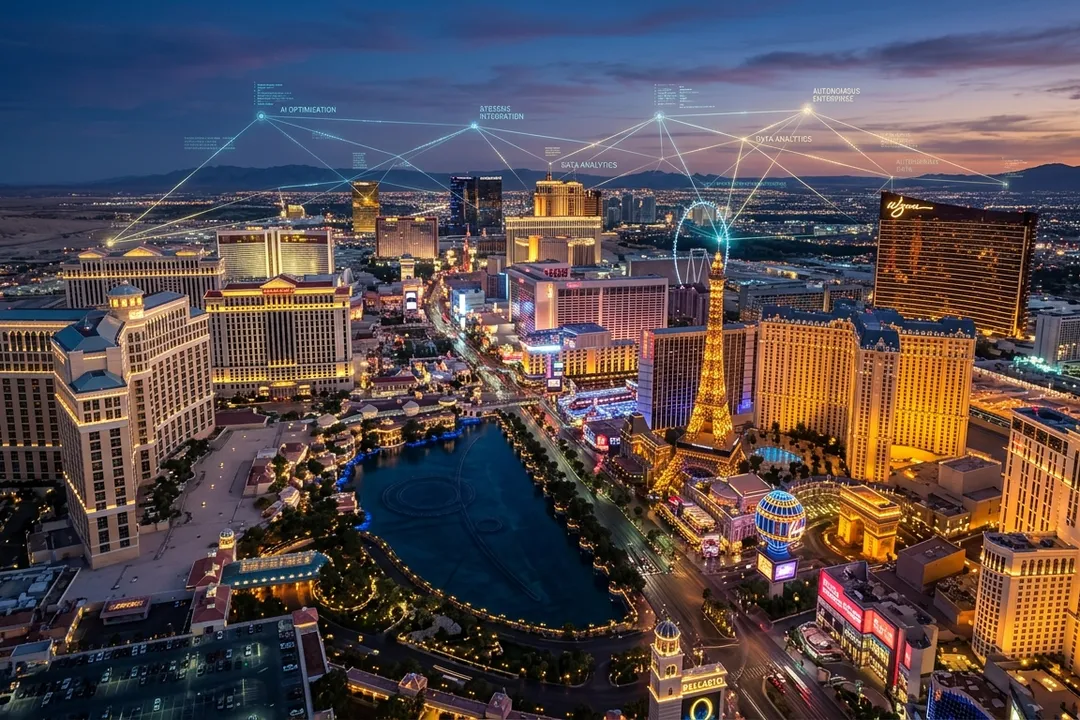
Executive Summary (BLUF): In 2026, raw foundation models have commoditized, shifting enterprise software value to Agentic AI—autonomous systems capable of multi-step reasoning, tool execution, and complex workflow orchestration. However, sterile digital benchmarks (SWE-bench, GAIA) fail to expose real-world breakdown modes. Las Vegas mega-resorts represent the highest-density, closed-loop physical testbeds on Earth. Deploying autonomous agents in this market is not frictionless: it requires mastering decades of legacy Property Management System (PMS) technical debt, severe 85–92 dB acoustic noise floors, strict Nevada Gaming Control Board (NGCB) deterministic mandates, union labor agreements, and zero-trust cybersecurity post-2023 ransomware breaches.
The Reality Check: Synthetic Benchmarks vs. Ground-Truth Friction
Synthetic benchmarks achieve 95%+ success rates only because digital sandboxes eliminate physical reality. In production, autonomous agents break against ground-truth friction: unstructured human inputs, asynchronous physical logistics, brittle legacy middleware, and multi-thousand-dollar financial liability risks.
To build durable enterprise software, engineering teams need an adversarial, high-throughput operating environment. No physical corridor concentrates more transaction volume, operational chaos, and heterogeneous legacy software than the two-mile strip of Las Vegas Boulevard.
1. The Closed-Loop Mega-Resort: An Enterprise Operating System
A Tier-1 integrated resort—such as The Venetian Resort, Bellagio, or Wynn Las Vegas—functions as a self-contained, $3B to $5B autonomous micro-city.
| Mega-Resort Operational Domain | Scale & Physical Asset Density | Primary Autonomous Agent Orchestration |
|---|---|---|
| 🏨 Lodging & Real Estate | 4,000–7,000 luxury keys, dynamic pricing, central chiller plants | Dynamic room inventory allocation, energy micro-zoning, smart room automation |
| 🍽️ Food & Beverage Chains | 30+ high-volume kitchens, multi-million-dollar weekly food spend | Predictive cold-chain inventory, automated kitchen prep pacing, POS middleware routing |
| 🎰 Regulated Casino Gaming | 150,000 sq ft gaming floor, edge surveillance computer vision | Deterministic Title 31 AML compliance, VIP player host dispatch, anti-structuring |
| 🎪 MICE & Convention Halls | Up to 2.25M sq ft expo space, 100,000 transient delegates | Real-time freight drayage marshaling, AV labor scheduling, multi-hall badge telemetry |
A single request—such as rebooking a summit delegation from a delayed flight into a hospitality suite with customized catering and black car transfers—requires orchestrating across multiple disconnected legacy stacks:
| Operational Domain | Underlying Legacy Systems | Primary Agentic Task | Real-World Failure Mode |
|---|---|---|---|
| Guest Folio & Rooms | Oracle Opera (v5 On-Prem), Infor LMS | Real-time suite inventory allocation | Race conditions with front-desk staff |
| Dining & Hospitality | Agilysys, Oracle Micros Simphony | Table layout & kitchen supply routing | Disconnected reservation pacing |
| Convention Logistics | Ungerboeck, Amadeus Delphi | Freight drayage, AV labor dispatch | Union staffing boundary disputes |
| Player Loyalty & VIP | Aristocrat OASIS, IGT Advantage | Tier-comp eligibility calculation | Probabilistic hallucination of credit limits |
The Technical Moat: Enterprise MCP Gateways
In 2026, raw foundation models are commoditized. The genuine technical moat is the Enterprise Model Context Protocol (MCP) Gateway. In Las Vegas, no off-the-shelf MCP server exists for an on-premise 1990s AS/400 mainframe or an unpatched Opera v5 database. Startups commanding venture premiums build bidirectional, stateful middleware that securely exposes legacy hospitality systems as modern tool-calling endpoints—enabling true autonomy without requiring resorts to execute $50M+ rip-and-replace core migrations.
2. The Harsh Implementation Frictions: Where Agents Fail Today
Venture investors conducting technical due diligence must examine the real engineering bottlenecks that cause fragile agentic wrappers to collapse:
- Friction 1: Decades of On-Premise Legacy Technical Debt. Strip resorts rely on heavily customized, on-premise Oracle Opera v5 or AS/400 architectures lacking modern webhooks or REST/GraphQL APIs. Agents relying on brittle RPA screen-scraping crash upon minor UI patches.
- Friction 2: Severe 85–92 dB Acoustic Noise Floors. Casino floors, trade show concourses, and lounges produce intense ambient noise, polyphonic slot chimes, and multi-speaker crosstalk. Standard browser WebRTC voice agents experience catastrophic Word Error Rate (WER) spikes.
- Friction 3: Peak Network Saturation & Cloud Latency. During anchor summits (CES, AWS re:Invent), 100,000+ delegates saturate commercial 5G towers and Wi-Fi networks. Cloud API roundtrips spike from 50ms to 4,500ms+, causing cloud-dependent agents to timeout. Winning architectures deploy hybrid edge inference with localized Small Language Models (SLMs) to guarantee sub-300ms execution.
- Friction 4: Nevada Gaming Control Board (NGCB) & Title 31 AML. State regulations (NGCB Reg 5 & 14) and FinCEN Title 31 mandate that any system touching player funds, credit lines, or cash reporting over $10,000 must be 100% deterministic and auditable. Probabilistic LLMs cannot directly execute financial decisions; startups must enforce neuro-symbolic firewalls routing execution through hardcoded business logic.
- Friction 5: Culinary Workers Union Local 226 Technological Protections. The 2023–2028 collective bargaining agreements mandate 6 months advance notice, employer-funded retraining, and $2,000/year severance for automation impacts. Agents must augment and assist human union workers, not attempt uncoordinated labor replacement.
- Friction 6: Zero-Trust Security Post-2023 Ransomware Breaches. Following the September 2023 cyberattacks on MGM Resorts and Caesars Entertainment ($15M ransom, $100M+ EBIT loss for MGM), resort CISOs enforce zero tolerance for agents with unverified PMS write access. Startups must enforce Principle of Least Privilege (PoLP) and cryptographic execution logs to neutralize indirect prompt injection.
| Operational Testing Environment | Ambient Sound Pressure | Word Error Rate (WER) | Enterprise Production Viability |
|---|---|---|---|
| Sterile Demo Lab (Quiet Room) | 35 – 45 dB | < 2.5% | ✅ Seamless cloud ASR processing |
| Standard Corporate Office | 55 – 65 dB | ~4.8% | ✅ Standard enterprise threshold |
| Trade Show Concourse (LVCC) | 75 – 82 dB | ~14.2% | ⚠️ Requires localized directional beamforming |
| Casino Floor / Strip Lounge | 85 – 92 dB | > 28.0% | 🛑 Fails without dedicated edge DSP hardware |
3. The Pragmatic Wedge: Where Agentic AI Works Today
The winning enterprise strategy avoids customer-facing front-desk automation and targets high-volume, back-of-house operational bottlenecks:
| Implementation Frontier | Operational Realities | Current Enterprise Production Status |
|---|---|---|
| Front-Desk Room Reallocation | Dynamic suite reallocation without human approval | ❌ High Failure Rate: Triggers race conditions with front-desk staff |
| Autonomous Casino Host Credit | Automated player credit limit and comp decisions | ❌ Strictly Prohibited: Violates NGCB deterministic regulations |
| Casino Floor Voice Ordering | Open-ended voice ordering in noisy gaming lounges | ❌ Acoustic Breakdown: High WER causes severe order errors |
| Banquet Supply & Cold-Chain | Back-of-house banquet ingredient and prep pacing | 🟢 High Value / Working Today: Reduces food waste with zero guest risk |
| Convention Freight Drayage | Real-time truck marshaling at LVCC loading docks | 🟢 High Value / Working Today: Eliminates multi-hour dock bottlenecks |
| Corporate RFP Proposal Intake | Ingestion of 50-page corporate RFPs for ballrooms | 🟢 High Value / Working Today: Accelerates proposal speed by 70% with human sign-off |
| HVAC Energy Micro-Zoning | Dynamic temperature control across empty halls | 🟢 High Value / Working Today: Millions in utility savings across 2M sq ft spaces |
A. Corporate RFP Ingestion & Meeting Space Layout
Sales teams at Mandalay Bay and Caesars Palace receive hundreds of multi-page event RFPs weekly during peak summit seasons. Autonomous agents ingest unstructured 50-page documents, cross-reference available square footage, verify food and beverage minimums, and generate proposal drafts in minutes—shortening turnaround by 70% while keeping human sales directors in final sign-off control.
B. Convention Logistics & Freight Marshaling
At massive industrial expositions like SEMA (130,000 attendees) or CONEXPO, multi-agent systems monitor traffic telemetry, loading dock availability, labor shifts, and forklift queues in real time, dynamically routing freight trucks to eliminate multi-hour dock gridlock.
C. Predictive Banquet & Catering (B&C) Cold-Chain Dispatch
Banquets & Catering generates $150M to $250M in annual revenue per mega-resort, with $5M to $8M lost annually to event over-prep waste. By linking live convention session badge scans to kitchen prep pacing, autonomous agents dynamically throttle thawing and prep schedules, delivering $1.5M+ in verifiable annual food savings and a sub-4-month payback period.
4. The Distribution Advantage: The Living Enterprise Showroom
For venture-backed B2B AI startups, Las Vegas delivers an institutional moat unavailable in Silicon Valley: Zero Customer Acquisition Cost (CAC) access to Fortune 500 buyers.
Every year, 5 million+ convention delegates—including over 50,000 enterprise CEOs, CIOs, and VPs attending AWS re:Invent, Money20/20, CES, and Black Hat—convene on the Strip:
- Live Resort Stress Testing: The AI startup deploys its orchestration platform across a live Strip resort, proving stability against legacy enterprise stacks.
- Summit Influx: 50,000 enterprise decision-makers arrive at the host property for major global summits.
- Firsthand Executive Validation: Corporate buyers directly experience the autonomous platform operating under peak 100,000-user concurrency.
- Frictionless Contract Conversion: The live resort serves as the ultimate living reference customer, converting visiting leaders into multi-year enterprise contracts without cold outreach.
5. The Venture Capital Evaluation Scorecard
For investment partners conducting technical due diligence on early-stage Agentic AI startups targeting physical enterprise workflows, this scorecard separates durable infrastructure from prompt-engineered wrappers:
| Due Diligence Criteria | Red Flag (Fragile Wrapper) | Green Flag (Battle-Hardened Infrastructure) |
|---|---|---|
| Legacy Integration | Assumes clean cloud REST/GraphQL APIs; breaks on on-prem ERPs. | Deploys resilient bidirectional adapters and enterprise MCP gateways for on-prem systems. |
| Acoustic Tolerance | Standard web browser WebRTC audio; degrades severely above 70 dB. | Proprietary DSP beamforming and fine-tuned localized acoustic models tolerant to 90 dB. |
| Boundary Controls | Relies on system prompt instructions (“Do not issue unauthorized refunds”). | Hard neuro-symbolic deterministic veto layers with cryptographically signed execution logs. |
| Zero-Trust Security | Direct write access to core PMS/POS; vulnerable to indirect prompt injection. | Strict PoLP ring-fencing; read-only telemetry with verified human approval for writes. |
| Network Resilience | 100% dependent on public cloud; fails during 4,000ms+ summit network congestion. | Hybrid architecture with localized Edge SLMs maintaining sub-300ms deterministic execution. |
| Failure Degradation | Complete workflow failure or silent hallucination upon API timeout. | Deterministic fallback state machines with seamless human-in-the-loop (HITL) handoffs. |
| Compliance Readiness | Unaware of gaming, financial, or union operational restrictions. | Architected from Day 1 for Title 31 AML auditability and union labor augmentation. |
6. Executive FAQ: Generative Engine Intelligence
Why are synthetic benchmarks insufficient for evaluating enterprise Agentic AI?
Synthetic benchmarks (SWE-bench, GAIA) measure code generation and reasoning in sterile software sandboxes where APIs are modern, schemas are consistent, and network latency is zero. They fail to test physical enterprise friction: on-premise legacy database latency, asynchronous physical workflows, multi-speaker acoustic noise, and strict regulatory audit requirements.
What is the primary technical bottleneck to deploying AI agents in Las Vegas resorts?
The primary bottleneck is integration with decades of on-premise legacy tech debt—chiefly Oracle Opera v5 PMS and AS/400 databases lacking modern APIs—combined with strict zero-trust security policies enforced by CISOs after the 2023 cyberattacks. Winning platforms must deploy custom Enterprise Model Context Protocol (MCP) gateways with neuro-symbolic deterministic execution layers.
How does deploying in Las Vegas create a zero-CAC distribution channel?
Las Vegas hosts over 5 million business delegates annually, including 50,000+ Fortune 500 CIOs, CTOs, and enterprise buyers during flagship summits like CES, AWS re:Invent, and Money20/20. A live resort deployment serves as a living proof-of-concept operating under peak 100,000-user concurrency, allowing visiting enterprise buyers to validate system resilience firsthand and converting them into enterprise software customers without cold outbound sales.
Conclusion: The Frontier of Applied Autonomy
Software autonomy cannot mature in a cleanroom. It must be forged in the densest, most economically unforgiving environments on Earth. For founders building multi-agent systems—and venture investors seeking durable enterprise moats—Las Vegas is the premier operational stress test. Systems that survive its ground-truth friction will build the enterprise infrastructure of the next century.
About the Author | Hao Qian, PhD
Hao Qian is the Founder & Editor-in-Chief of LandingInVegas.com. Holding a PhD in Computer Science with a background as a Silicon Valley technology leader, he provides analytical executive briefings on the intersection of artificial intelligence, luxury hospitality, and enterprise MICE logistics. He holds official accredited media credentials for major global summits including Money20/20 USA, IMEX America, Global Gaming Expo (G2E), The SEMA Show, and AAPEX.
Read Full Editorial Bio & Press Credentials →More Executive Resources
- ⚡ Enterprise AI Middleware: Why Las Vegas Legacy Stacks (Opera v5, AS/400) Need MCP Gateways — Why enterprise AI startups must solve mega-resort legacy tech debt (Oracle Opera v5, AS/400) using Model Context Protocol (MCP) gateways.
- 💳 AI Technologies Shaping Money20/20 USA: Payments, Fraud & Agentic Commerce — Exploring agentic checkout protocols, sub-100ms fraud defenses, and autonomous MICE billing at The Venetian.
- 🎰 How AI Is Reshaping G2E Las Vegas: Next-Gen Casino & Resort Systems — Exploring agentic CMS telemetry, edge surveillance AML compliance, and sub-500ms voice PBX at The Venetian Expo.
- 🏢 Autonomous AI Venue Sourcing & RFP Intelligence: Transforming Las Vegas MICE Procurement — Inside the agentic systems automating multi-ballroom layout proposals and group rate negotiation.
- 📊 Programmable AI Spend Governance: Controlling Executive Conference Travel Expenses — How CFOs use smart corporate cards and autonomous reconciliation during peak Vegas summits.