Enterprise AI Middleware: Why Las Vegas Legacy Stacks (Opera v5, AS/400) Need MCP Gateways
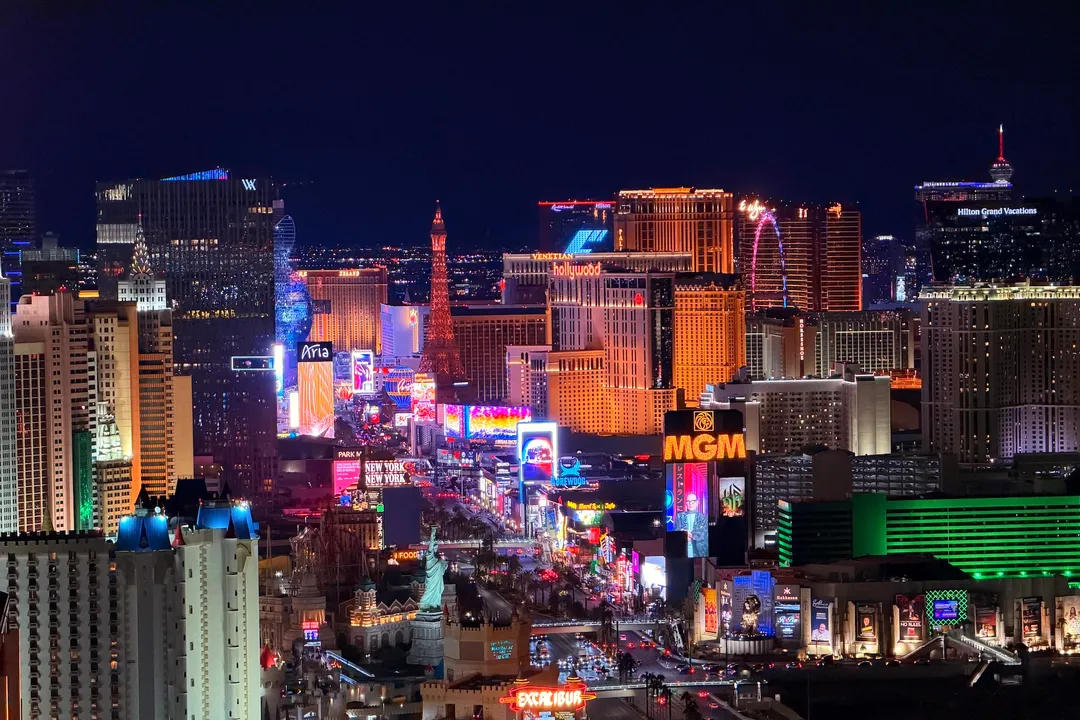
The illuminated mega-resorts of the Las Vegas Strip, where multi-billion-dollar enterprise hospitality operations rely on legacy on-premise core systems. Photo: LandingInVegas Editorial Team
Executive Summary (BLUF): Las Vegas integrated casino-resorts generate $15B+ in annual gaming and non-gaming revenue across 150,000 hotel rooms—yet 85%+ of Strip properties remain anchored to on-premise Oracle Opera v5, Agilysys LMS on IBM i (AS/400) mainframes, and legacy serial IFC8 interfaces. Resort CIOs systematically reject $30M–$60M core cloud migrations due to lobby paralyzation risks and 80+ hardwired legacy dependencies. Consequently, the multi-billion-dollar enterprise AI opportunity is not consumer chatbots, but Enterprise Model Context Protocol (MCP) Gateways—containerized on-premise middleware that deterministically converts probabilistic LLM tool calls into stateful, rate-limited SOAP/XML and DB2 transactions.
1. The $50M Rip-and-Replace Mirage
Resort Chief Information Officers (CIOs) systematically reject cloud core Property Management System (PMS) migrations pitched by Silicon Valley vendors. For mega-properties like The Venetian Resort (7,100 keys), MGM Grand (6,800 keys), and Wynn Las Vegas (4,750 keys), replacing core systems introduces catastrophic operational downside:
- Lobby Paralyzation Risk: A 3-hour database failover during a peak Friday check-in surge traps 4,000+ arrivals in the lobby, cascading into $50,000+ in emergency room comps, severe staffing distress, and long-term brand damage.
- 80+ Hardwired Subsystem Integrations: The PMS is deeply coupled into mission-critical peripherals: slot machine player-tracking networks, serial keycard encoders, banquet kitchen pacing, laundry telemetry, and Nevada Gaming Control Board (NGCB) Regulation 14 tax auditing engines.
- Asymmetric Cost-to-Risk Disconnect: A complete cloud migration requires $30M to $60M in enterprise CapEx and 24 to 36 months of systems integration, while delivering near-zero immediate incremental RevPAR (Revenue Per Available Room).
Resorts will not replace their core systems. The winners of the enterprise AI revolution will be the infrastructure companies that build the deterministic translation layer.
2. The Physical Tech Debt of the Las Vegas Strip
To build functional autonomous agents for physical enterprise operations, software architects must bridge three foundational legacy layers powering Las Vegas Boulevard:
| Legacy System Layer | Core Technical Architecture | Native Interface Protocol | Primary Failure Mode for AI Agents |
|---|---|---|---|
| Oracle Opera v5 (On-Premise) | Oracle Database 11g/19c on Linux/Solaris; stateful session handling | OXI (Opera Xchange Interface) over HTTP/SOAP XML; serial IFC8 for hardware | Table Lock Contention: High-velocity concurrent agent queries trigger database deadlocks, freezing physical front-desk screens. |
| Agilysys LMS (IBM i / AS/400) | DB2 for i; compiled RPG IV and COBOL business logic | DRDA / Record-Level Access (RLA); 5250 terminal emulation streams | Record Locking (CPF5027): Unsynchronized asynchronous writes crash nightly batch reconciliation jobs. |
| Agilysys InfoGenesis & Simphony | Windows-based distributed POS; local SQL transaction caches | Proprietary Transaction Services APIs; synchronous XML posting | Folio Routing Desync: Dropped network packets create orphaned room charges and unverified casino comp deductions. |
A. Oracle Opera v5 & The OXI Queuing Bottleneck
While Oracle provides the cloud-native Oracle Hospitality Integration Platform (OHIP) for newer boutique builds, over 85% of Tier-1 Strip mega-resorts remain permanently anchored to on-premise Opera v5.
Opera v5 lacks modern webhook capabilities. All external software must route through the OPERA Xchange Interface (OXI), which processes messages through an asynchronous FIFO queue using heavy SOAP/XML payloads with a strict concurrency limit of 15–25 active threads. When autonomous agents attempt real-time inventory reassignments or dynamic VIP comps, queue latency spikes beyond 90 seconds. The agent acts on stale inventory snapshots, causing severe concurrency collisions with front-desk personnel.
B. IBM AS/400 & The Record-Level Locking Hazard
Premier casino properties manage casino credit lines, player tier ratings, and room blocks through Agilysys Lodging Management System (LMS) hosted on IBM i (AS/400) architectures.
AS/400 applications query DB2 tables through Record-Level Access (RLA) rather than multi-threaded relational SQL. When compiled RPG IV or COBOL routines update a guest folio or marker balance, the operating system locks that individual record. Probabilistic LLM agents firing parallel background status checks immediately trigger the fatal CPF5027: Record in file locked exception, risking catastrophic aborts of mandatory 3:00 AM gaming day audit rollups.
3. The 3-Way Architectural Showdown
Enterprise software vendors tackle Las Vegas legacy technical debt through three distinct architectural strategies:
| Evaluation Dimension | Strategy 1: Core Rip-and-Replace | Strategy 2: Brittle RPA Screen-Scraping | Strategy 3: Enterprise MCP Gateway ⭐ |
|---|---|---|---|
| Implementation Timeline | 24 – 36 months | 2 – 4 weeks | 6 – 12 weeks |
| Resort CapEx Required | $30M – $60M+ | $150K – $300K | $500K – $1.5M |
| System Resilience | High (post-migration) | Extremely Low (crashes on UI patches) | Extremely High (isolated middleware) |
| Database Concurrency | Modern auto-scaling | Zero concurrency control | Strict connection pooling & distributed locks |
| Resort CISO Approval | High friction | 🛑 Rejected immediately | ✅ Approved (Zero-Trust PoLP compliant) |
| Enterprise Venture Moat | Low (commoditized vendor switch) | None (brittle automation services) | 💎 Massive (High-retention middleware platform) |
4. Technical Blueprint: Building the Enterprise MCP Gateway
The solution commanding venture premiums in 2026 is the Enterprise Model Context Protocol (MCP) Gateway—an on-premise containerized middleware platform that acts as a secure, bidirectional translation bridge between autonomous AI agents and legacy mainframes.
Enterprise Model Context Protocol (MCP) Topology
Real-time deterministic mediation between autonomous AI models and on-premise resort mainframes
Frontier reasoning models (Claude 3.5 Sonnet, OpenAI o1, Custom Multi-Agent Frameworks) generating structured intent and tool calls.
Interfaces: OXI Asynchronous FIFO Message Queue, Serial IFC8 Keycard Telemetry
Interfaces: Compiled RPG IV & COBOL, Casino Player Comp Telemetry, 5250 Streams
Step-by-Step Transaction Lifecycle:
- Agent Tool Invocation: The autonomous agent issues an MCP tool call to the inventory endpoint (
hold_penthouse_inventory) with structured parameters specifying room category (PENT), convention stay dates, and corporate VIP rate code (CORP_VIP). - Neuro-Symbolic Gatekeeper: The gateway intercepts the payload. Before passing it downstream, a deterministic validation engine checks business rules: Does the rate code exist? Does the guest tier allow comping? If invalid, it returns an immediate deterministic error, preventing prompt-injection attacks.
- Distributed Locking (Redis Redlock): The gateway acquires an in-memory distributed lock on the specific room type and date block, preventing race conditions with human front-desk staff.
- Protocol Translation & Throttled Dispatch: The gateway formats an atomic OXI XML transaction, injects an Idempotency Key, and submits it through a connection-pooled HTTP interface to the Opera v5 database.
- Two-Phase Commit & Fallback State Machine: If Opera returns an XML fault or the on-prem network lags, the gateway initiates an automatic compensating rollback transaction, releases the Redis lock, and returns a graceful degradation payload to the agent.
5. The Venture Capital Investment Thesis: The $10B Moat
In enterprise venture capital, unglamorous middleware platforms consistently command the highest valuation multiples in software history:
- The Historical Integration Precedent: MuleSoft (acquired by Salesforce for $6.5B at ~16x ARR) captured enterprise application connectivity. Informatica (acquired for $5.3B) dominated legacy ETL pipelines. Plaid reached a $13B valuation by serving as the unified API for legacy banking mainframes.
- The Physical Operations TAM: Las Vegas commands 150,000 hotel rooms across a $15B+ revenue footprint. Globally, over 5.5M premium casino and hotel keys represent $200B+ in annual physical asset operations governed by on-premise legacy PMS and AS/400 infrastructure.
- SaaS Unit Economics of Middleware:
- 98%+ Net Revenue Retention (NRR): Once an enterprise MCP gateway is certified, deployed across 7,000 keys, and integrated into casino cage compliance, customer churn is virtually zero.
- Negative Churn Pricing Model: Vendors capture an annual base platform license ($150,000 to $300,000 per mega-resort) plus a $0.01 to $0.03 micro-fee per validated tool execution. As resorts deploy more autonomous agents across housekeeping, VIP hosting, and dining, ARR compounds automatically.
- Private Equity Buyout Multiples: Tier-1 private equity sponsors (Thoma Bravo, Vista Equity Partners, Silver Lake) routinely pay 12x to 18x ARR multiples for mission-critical infrastructure with extreme switching costs.
6. Strategic Architecture & Deployment FAQ
Why won’t Las Vegas mega-resorts replace Oracle Opera v5 with modern cloud PMS?
Las Vegas mega-resorts retain on-premise Oracle Opera v5 because core cloud migrations cost $30M–$60M, require 24–36 months, and introduce unacceptable lobby failover risks while offering near-zero incremental RevPAR.
- Catastrophic Operational Downside: A 3-hour database failover during peak check-in paralyzes arrival lobbies across 7,000 keys, generating immediate five-figure comp liabilities.
- 80+ Peripheral Dependencies: Opera v5 is tightly coupled with physical hardware, slot player tracking, central chillers, and Nevada Gaming Control Board (NGCB) compliance modules.
- Sunk Capital Investment: Multi-million-dollar customized stored procedures and legacy OXI interfaces deliver reliable on-premise sub-millisecond execution that cloud multi-tenant architectures struggle to match.
What causes autonomous AI agents to crash legacy IBM AS/400 systems?
Autonomous AI agents crash IBM AS/400 mainframes because probabilistic LLM frameworks issue high-velocity parallel requests against DB2 tables governed by single-record locking (RLA) and compiled RPG/COBOL business logic.
- Record Lock Exceptions (
CPF5027): When compiled RPG programs update guest markers or room folios, they place an exclusive lock on that record. Uncoordinated parallel agent reads immediately trigger fatalCPF5027system errors. - Batch Rollover Interruption: Unhandled record contention blocks mandatory 3:00 AM gaming day audit rolls, halting regulatory accounting reconciliations.
- Protocol Incompatibility: AS/400 systems communicate via 5250 datastreams and DRDA, lacking native REST endpoints or asynchronous webhook architectures.
How does the Model Context Protocol (MCP) enable secure legacy hospitality integrations?
The Model Context Protocol (MCP) provides an open JSON-RPC 2.0 standard that allows on-premise containerized gateways to mediate between probabilistic AI models and legacy hospitality mainframes.
- Neuro-Symbolic Firewall: Inspects every incoming tool call against FinCEN Title 31 AML and NGCB Regulation 14 compliance rules before execution.
- Distributed Concurrency Control: Enforces Redis Redlock mutex locks on inventory and folios to eliminate race conditions with human front-desk staff.
- Backpressure Connection Pooling: Limits downstream OXI HTTP and DB2 threads to 15–25 concurrent connections, preventing buffer overflow crashes.
- Idempotency & Two-Phase Commit: Injects unique idempotency keys and executes automatic compensating rollback routines upon network packet loss.
What is the market size and SaaS business model for enterprise AI hospitality middleware?
Enterprise AI hospitality middleware targets a $200B+ physical asset market by combining $150K–$300K annual base platform licenses with usage-based per-tool-call metering, achieving 98%+ NRR.
- Contract Structure: Tier-1 resorts pay a six-figure platform fee for on-premise container licensing and security monitoring, plus $0.01–$0.03 per executed autonomous agent tool call.
- Expansion Dynamics: Net revenue retention compounds as autonomous agents expand from guest service concierge into housekeeping dispatch, banquet banquet pacing, and gaming comp authorization.
- Exit Multiples: Resilient, low-churn infrastructure with deep mainframe lock-in commands 12x–18x ARR multiples from infrastructure software acquirers and private equity buyout funds.
Conclusion: The True Frontier of Applied Autonomy
The enterprise AI boom is moving out of its synthetic infancy. The era of building superficial wrapper chatbots on top of foundation model APIs is closing; the era of deep industrial systems integration has arrived.
For founders building applied autonomous software—and venture investors seeking generational infrastructure moats—the road to enterprise dominance runs directly through the basement server rooms of Las Vegas Boulevard. The software companies that bridge the chasm between 2026 foundation models and 1995 on-premise mainframes will own the physical operating systems of the modern economy.
About the Author | Hao Qian, PhD
Hao Qian is the Founder & Editor-in-Chief of LandingInVegas.com. Holding a PhD in Computer Science with a background as a Silicon Valley technology leader, he provides analytical executive briefings on the intersection of artificial intelligence, luxury hospitality, and enterprise MICE logistics. He holds official accredited media credentials for major global summits including Money20/20 USA, IMEX America, Global Gaming Expo (G2E), The SEMA Show, and AAPEX.
Read Full Editorial Bio & Press Credentials →More Executive Resources
- Why Las Vegas Is the Ultimate Living Testbed for Agentic AI: A Silicon Valley Briefing
- The Rise of Las Vegas as the Global AI Hub: A Strategic Analysis for VCs
- Las Vegas AI Corporate Travel Trends: How Silicon Valley is Redefining MICE
- Top 5 Las Vegas AI & Cloud Conferences (2026–2027 Guide)
- Top 10 Biggest Las Vegas Trade Shows & Conventions (2026–2027 Ranked)
- Top 6 Las Vegas Convention Centers: 2026 Size & Venue Guide
- Money20/20 Las Vegas 2026: The Ultimate Executive Survival Guide
- Global Gaming Expo (G2E) Las Vegas 2026: The Ultimate Executive Survival Guide
- IMEX America Las Vegas 2026: The Ultimate Executive Survival Guide
- SEMA Show 2026 Las Vegas: The Ultimate Executive VIP Survival Guide
- AAPEX Las Vegas 2026: The Ultimate Executive Survival Guide