Key AI Technologies Shaping Money20/20 Las Vegas: An Executive Briefing
Editorial Note: LandingInVegas is an officially accredited media outlet covering Money20/20 USA 2026.
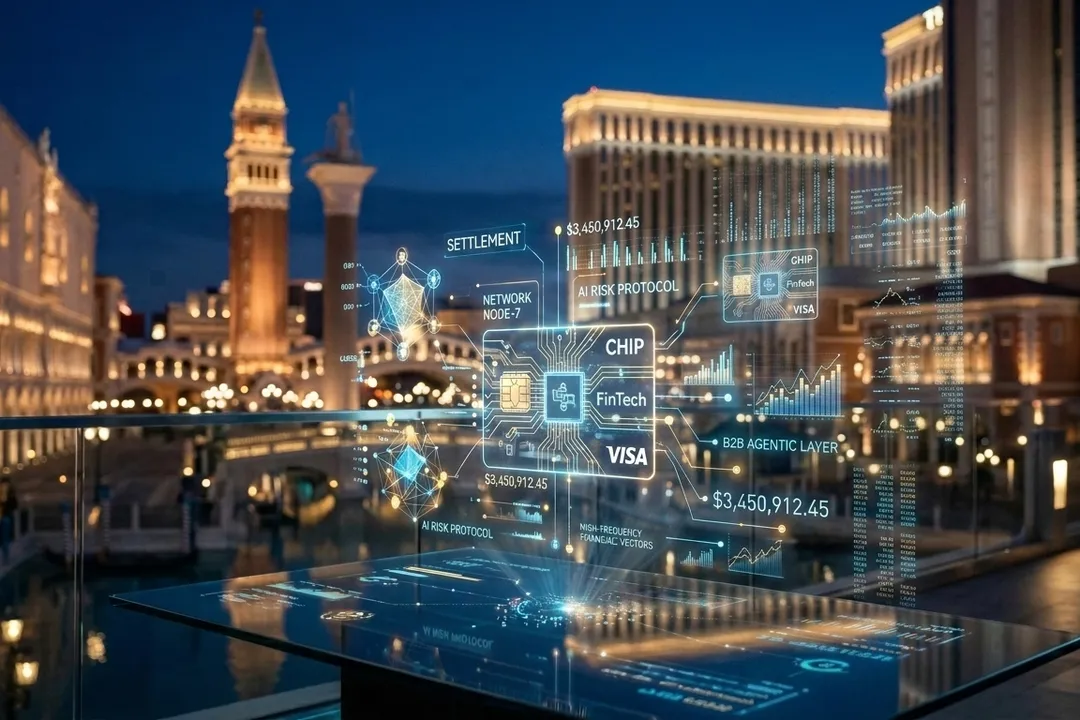
When tens of thousands of C-level executives, venture capitalists, and financial architects convene at The Venetian Resort & Expo for Money20/20 USA (October 18–21, 2026), the industry discourse is no longer debating experimental AI chatbots. The conversation has officially shifted to core financial systems execution: how autonomous AI agents safely control, negotiate, and settle multi-million-dollar capital flows.
For C-Suite leaders and investors, navigating the summit floor requires cutting through generic consumer AI hype. The real enterprise value is concentrated across four transformative AI architectural pillars that are redefining transaction velocity, boardroom fraud liability, and corporate spend governance.
| 🤖 AI Architectural Pillar | ⚡ Core Breakthrough & Enterprise Mechanism | 🎯 C-Suite & VC Impact |
|---|---|---|
| 1. “Act-to-Transact” Agentic Commerce | Autonomous AI procurement agents with tokenized virtual cards & smart wallets | Machine-to-Machine (M2M) micro-settlements & programmatic zero-friction spend |
| 2. Voice Deepfake & Synthetic Fraud Defense | Sub-millisecond acoustic frequency analysis & device behavioral biometrics | Stops AI-cloned executive wire fraud (Vishing) and boardroom liability |
| 3. Autonomous AP/AR & Continuous Close | Multi-modal Vision OCR extracting itemized line items, taxes, & NetSuite GL codes | Real-time FedNow settlement eliminating the 25-day manual month-end close |
| 4. Explainable AI & Deterministic Governance | Hybrid LLMs paired with hard mathematical veto rules & auditable logs | 100% audit-ready compliance satisfying SEC, CFPB, and Federal Reserve mandates |
1. “Act-to-Transact” Agentic Commerce: Autonomous Procurement & Smart Wallets
The primary technological leap at this year’s summit is the transition from conversational copilots to autonomous transacting agents.
Historically, AI software functioned as passive information aggregators. Today, developer platforms led by Stripe Issuing, Anthropic, and Skyflow are equipping autonomous software agents with tokenized virtual cards and single-use cryptographic wallets.
- Autonomous Corporate Procurement: Enterprise software agents autonomously analyze multi-vendor RFP quotes, negotiate dynamic pricing discounts, and execute payments within pre-set corporate spend parameters.
- Machine-to-Machine (M2M) Micro-Settlement: Autonomous cloud compute clusters, IoT logistics fleets, and digital advertising nodes negotiate and settle real-time micropayments without human friction.
- The VC Thesis: Venture capital allocators at Money20/20 are prioritizing the foundational infrastructure layer—the identity verification, wallet APIs, and tokenized rails required to power autonomous agent transactions.
2. Voice Deepfake & Synthetic Fraud Defense: The Sub-Millisecond Shield
As financial institutions automate their channels, cybercriminals are weaponizing generative voice AI. The financial sector has experienced a dramatic surge in “Vishing” (Voice Phishing), where bad actors clone a CEO’s or CFO’s vocal frequencies from public keynote recordings to bypass corporate bank voice verification and initiate unauthorized multi-million-dollar wire transfers.
At The Venetian, security pioneers including Mastercard Decision Intelligence, Sardine, Alloy, and Reality Defender are showcasing real-time defensive AI architectures:
- Sub-Millisecond Acoustic Forensics: Deep learning audio transformers analyze live telephone audio streams in under 50 milliseconds, detecting mechanical frequency artifacts unique to AI voice diffusion models.
- Behavioral Biometrics: Machine learning models track device gyroscope telemetry, touch pressure, and keystroke cadence to distinguish genuine human account holders from automated headless bots.
- Graph Neural Network (GNN) Risk Scoring: Cross-institution identity graphs that identify and freeze distributed botnets attempting multi-bank synthetic account creation simultaneously.
3. Autonomous AP/AR & Continuous Accounting: Eliminating the Month-End Close
Enterprise CFOs have historically struggled with the legacy 25-day manual “month-end close.” Finance departments drown in thousands of mismatched paper receipts, delayed hotel folios, and conflicting general ledger entries following major trade shows.
Emerging FinTech leaders (Ramp, Brex, Navan Expense, and Rillet) are deploying Cascaded Multi-Modal AI Pipelines that compress reconciliation from 3 weeks to under 48 hours:
| 🔢 Step | 🏢 Processing Stage | ⚡ Technology & Execution Mechanism | ⏱️ Latency & Outcome |
|---|---|---|---|
| 1 | POS Terminal Swipe | Waiter dips/taps physical card at Wynn / Venetian | ISO 8583 financial dispatch to network |
| 2 | Deterministic Gateway | Hard rule evaluation (MCC dining code, budget limit) | < 50ms real-time authorization |
| 3 | Multi-Modal Vision OCR | Employee snaps receipt photo on mobile app | Extracts subtotal, 8.375% tax, and gratuity |
| 4 | LLM Accounting Agent | Evaluates IRS deduction rules & calendar attendee list | Categorizes GL Code 6020 (Client Dining) |
| 5 | Instant Settlement Rail | FedNow / RTP real-time interbank transfer | Settles and transfers funds in < 2s |
| 6 | ERP General Ledger | Oracle NetSuite / Workday REST Web Services sync | Reconciled in real time (Zero human delay) |
- Multi-Modal Receipt Parsing: Vision LLMs ingest unstructured receipt photos, itemized banquet invoices, and foreign currency folios, accurately separating Clark County sales taxes (8.375%), alcohol charges, and service gratuities.
- Real-Time Rails Integration: By pairing AI parsing with FedNow and RTP (Real-Time Payments) rails, transactions settle and map to Oracle NetSuite, Workday, or Sage Intacct chart of accounts in real time.
4. Explainable AI (XAI) & Deterministic Governance: Regulatory Immunity
Financial institutions operating under the supervision of the Federal Reserve, CFPB, and SEC cannot deploy “black-box” models. If an algorithmic engine denies credit, freezes a treasury transfer, or flags an enterprise customer, federal compliance mandates an auditable, non-discriminatory explanation.
To solve this, leading enterprise architectures are converging on Hybrid AI Governance:
- Probabilistic Intelligence for Discovery: LLMs handle unstructured text processing, document comprehension, and anomaly detection.
- Deterministic Guardrails for Execution: Hard mathematical rule engines enforce transaction caps, Merchant Category Code (MCC) restrictions, and compliance boundaries. The AI reasons, but the deterministic code holds the final veto.
- Audit-Ready Reasoning Logs: Platforms like DataRobot and Zest AI generate immutable, human-readable decision logs for every automated underwriting and risk event.
Strategic Executive Takeaways
For C-Suite leaders, FinTech founders, and venture capital allocators attending Money20/20 at The Venetian:
- Shift from Chatbots to Autonomous Wallets: Prioritize startups building the tokenized identity, programmatic card rails, and wallet interfaces that empower AI agents to transact autonomously.
- Harden Boardroom Liability: Deploy sub-millisecond acoustic and behavioral biometrics to defend corporate treasury channels against generative voice cloning (Vishing) wire scams.
- Demand Continuous Accounting: Eliminate manual accounting friction by integrating multi-modal receipt parsing directly with FedNow and real-time ERP ledgers.
- Enforce Deterministic Compliance: Ensure every deployed AI system pairs generative reasoning with hard, audit-ready deterministic veto guardrails to satisfy SEC and CFPB oversight.
About the Author | Hao Qian, PhD
Hao Qian is the Founder & Editor-in-Chief of LandingInVegas.com. Holding a PhD in Computer Science with a background as a Silicon Valley technology leader, he provides analytical executive briefings on the intersection of artificial intelligence, luxury hospitality, and enterprise MICE logistics. He holds official accredited media credentials for major global summits including Money20/20 USA, IMEX America, Global Gaming Expo (G2E), The SEMA Show, and AAPEX.
Read Full Editorial Bio & Press Credentials →More Executive Resources
- 🎰 How AI Is Reshaping G2E Las Vegas: Next-Gen Casino & Resort Systems — Exploring agentic CMS telemetry, edge surveillance AML compliance, and sub-500ms voice PBX at The Venetian Expo.
- Money20/20 Las Vegas 2026: The Ultimate Executive Survival Guide — Essential VIP logistics, Venetian navigation, private dining reservations, and executive black car transfers.
- Agentic Corporate Travel in Las Vegas: Predictive Flight Disruption & Executive Logistics — In-depth architectural analysis of autonomous GDS travel rebooking and real-time airport telemetry.
- AI Corporate Spend Governance in Las Vegas: Programmable Budgets & Autonomous AP/AR — How CFOs utilize programmable cards and real-time ledger sync to control high-volume summit budgets.